
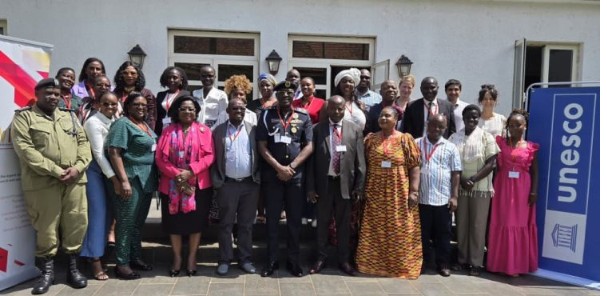
The Nigeria Security and Civil Defence Corps (NSCDC) has reaffirmed its commitment to prioritising the safety and protection of female journalists across the country.
The FCT Commandant of the Corps, Dr. Olusola Odumosu, made this known while speaking at a regional training workshop organised by the International Association of Women in Radio and Television (IAWRT) in collaboration with UNESCO in Entebbe, Uganda.
The two-day workshop brought together journalists, lawyers, and law enforcement officers from across Africa to deliberate on the theme, “Monitoring and Reporting on the Safety of Journalists in Africa with a Focus on Gender.”
Presenting a paper titled “From Report to Response: How Cases of Attacks Against Female Journalists Are Handled,” Dr. Odumosu noted that reports on Gender-Based Violence (GBV) reveal that female journalists remain more vulnerable to attacks than their male counterparts.
He emphasised the need for a gender-sensitive and trauma-informed approach to protecting media practitioners, stressing that institutional mechanisms must be strengthened to support such efforts.
According to him, security agencies must prioritise policy reforms, capacity building, data management, and stronger accountability frameworks while collaborating more closely with media stakeholders.
Dr. Odumosu further advocated for an institutional culture that condemns, investigates, and punishes all forms of violence against women journalists.
“We must allocate resources for gender desk officers, establish rapid response protocols, commit to quarterly data reporting on incidents involving female journalists, and engage proactively with media houses and journalists’ associations to build trust and coordination,” he stated.
He noted that these measures would not only safeguard the lives of female journalists but also uphold democratic values, national security, and public safety.
The NSCDC Commandant also highlighted the Corps’ efforts, in partnership with other security agencies, to reduce attacks on journalists and citizens through the establishment of gender desks and specialised training in GBV response.
However, he identified persistent challenges such as under-reporting of GBV cases, digital threats, weak institutional response, and limited accountability, urging all stakeholders to work collaboratively to bridge these gaps.
The workshop drew participants from the media, legal, and security sectors across West, East, North, and Southern Africa.

NSCDC Promises Stronger Protection For Women In Media. added by editor on
View all posts by editor →