
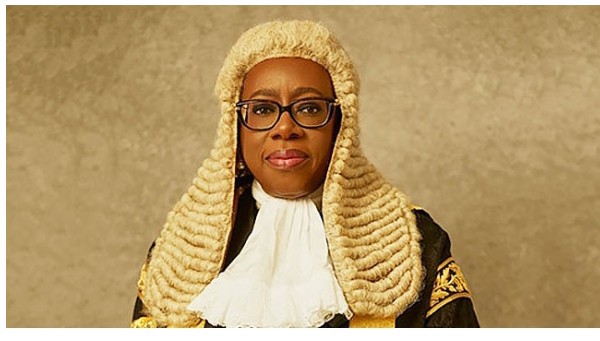
The Chief Justice of Nigeria (CJN), Justice Kudirat Kekere-Ekun, has warned the media against misrepresentation and sensational reporting that could erode public confidence in the justice system and weaken democratic institutions.
She gave the warning in Abuja at the annual conference of the National Association of Judiciary Correspondents (NAJUC), Abuja.
In her keynote address, Kekere-Ekun, who underscored the critical role of the media in shaping public understanding of judicial processes, called on judiciary correspondents to uphold the highest standards of professionalism.
The CJN, who was represented by the Administrator of the National Judicial Institute, Justice Babatunde Adejumo, emphasised that judiciary correspondents serve as a vital bridge between the Bench and the public, describing their role as “democratic in character” and indispensable to sustaining trust in the administration of justice.
While noting that the judiciary’s impact extends beyond courtroom decisions, Justice Kekere-Ekun warned that inaccurate, incomplete, or sensational reporting of court proceedings could undermine the rule of law. She stressed that even the most well-reasoned judgements achieve their purpose only when properly understood by the public.
“In every constitutional democracy, the strength of institutions is measured not only by the decisions they make, but by the degree to which those decisions are understood, trusted, and accepted by society. Misinterpretation or sensationalism can unintentionally erode confidence in the judiciary, while accurate and balanced reporting strengthens institutional credibility,” she stated.
Acknowledging the complexities of legal reporting, Kekere-Ekun noted that court proceedings are often technical and require careful interpretation, even as journalists operate under tight deadlines and editorial pressures.
She, however, charged media practitioners to prioritise accuracy, context, and fairness in their reports, especially as Nigeria approaches the 2027 general elections.
According to her, election-related disputes will test the resilience of democratic institutions, placing a dual responsibility on the judiciary to deliver impartial decisions and on the media to communicate such outcomes responsibly.
Kekere-Ekun commended NAJUC for its commitment to capacity building and informed reportage of judicial activities, formally declaring the conference open and expressing optimism that its deliberations would further strengthen Nigeria’s democracy.
The Attorney-General of the Federation (AGF) and Minister of Justice, Prince Lateef Fagbemi (SAN), also warned against what he described as “political desperadoes,” saying they must learn to act responsibly and within the laws of the land.
Represented by the Special Assistant on Legislative Drafting in the Office of the AGF, Hussein Oloyede, Fagbemi commended the role of the media in deepening democracy, noting that journalists shape political behaviour and expectations in any election.
He appealed to journalists to shun political actors with divisive tendencies and ensure the unity and development of the country.
Fagbemi said activities towards the 2027 general elections have commenced, adding that the media has a critical role to play.
“As the main bridge between INEC, political actors, and over 90 million potential voters, the press shapes expectations, trust, and behaviour before ballots are cast and after results are declared,” he said.
“It is on this note that I urge the media not to give room to political actors trying to tear the fabric of this nation. The media must remember we need to have our country first before we can talk about elections. Those fanning the embers of hatred must be stopped.”
He added that government agencies would not hesitate to act against anyone who runs foul of the law.
Earlier, in his welcome address, the Chairman of NAJUC Abuja, Mr Kayode Lawal of Daily Post Media, called for reforms in the judiciary to safeguard democracy ahead of the 2027 general elections.
He raised concerns over the integrity of the justice system, warning that conflicting court orders—particularly in politically sensitive cases—pose a serious threat to national stability.
He cited a recent dispute involving parallel rulings by the Federal High Court in Abuja and the Oyo State High Court over the 2025 convention of the Peoples Democratic Party (PDP) as a troubling example.
“The situation is capable of causing chaos and setting the political stage ablaze,” he said, describing the trend as “worrisome and pathetic.”
Lawal said the conference, themed “The Role of Judiciary in Deepening Democracy in Nigeria,” aims to foster dialogue between legal practitioners and the media while addressing systemic challenges in the judiciary.
He also referenced growing public concerns about judicial integrity, urging reforms to strengthen independence and reduce external influence. He called for an autonomous funding mechanism for the judiciary to reduce dependence on the executive arm of government.
Lawal further urged the Nigerian Bar Association (NBA) to strengthen disciplinary measures against legal practitioners involved in unethical conduct, including facilitating conflicting court orders.
He warned that as the 2027 elections approach, the judiciary must reaffirm its position as the last hope of the common man.
He also cautioned against political narratives that dismiss electoral malpractice while urging aggrieved parties to seek redress in Court, saying such attitudes could further erode public trust in democratic institutions.
The NAJUC chairman commended the National Judicial Council (NJC) and other stakeholders for their contributions to the conference, while expressing appreciation to colleagues for their support during his tenure

CJN Cautions Media Against Sensational Reporting. added by editor on
View all posts by editor →